
// Free and open source
An agent that remembers. In a folder you own.
It knows your projects, your people and your rules, and keeps all of it as plain files on your computer. Runs on Claude Code or Codex, with more frontier and open-weight models coming.
// How it remembers
01
Sessions
Every conversation, saved when it ends.
↓ capture
02
Knowledge
Compiled into notes it reads before you type.
↓ informs
03
Projects
Tasks and plans it keeps current.
↓ generate
04
Results
Briefs, reviews and shipped work.
↓ feeds the next session ↺
Every session is saved when it ends and compiled into notes. Those notes load before you type a word in the next session, so it starts each day knowing what you did yesterday.
// Meet Oppi
Many arms. One brain.
Your agent wakes up as Oppi, an octopus: many arms at work, one brain behind them. Every session you run is an arm. The sidebar shows them all: who needs you, what’s running, and each agent’s projects, reports and goals, one tap from the file behind it.
Run as many agents as you like, each in a folder of its own: one for you, one for support, one per team. The sidebar keeps track of them.

// The sidebar, view by view
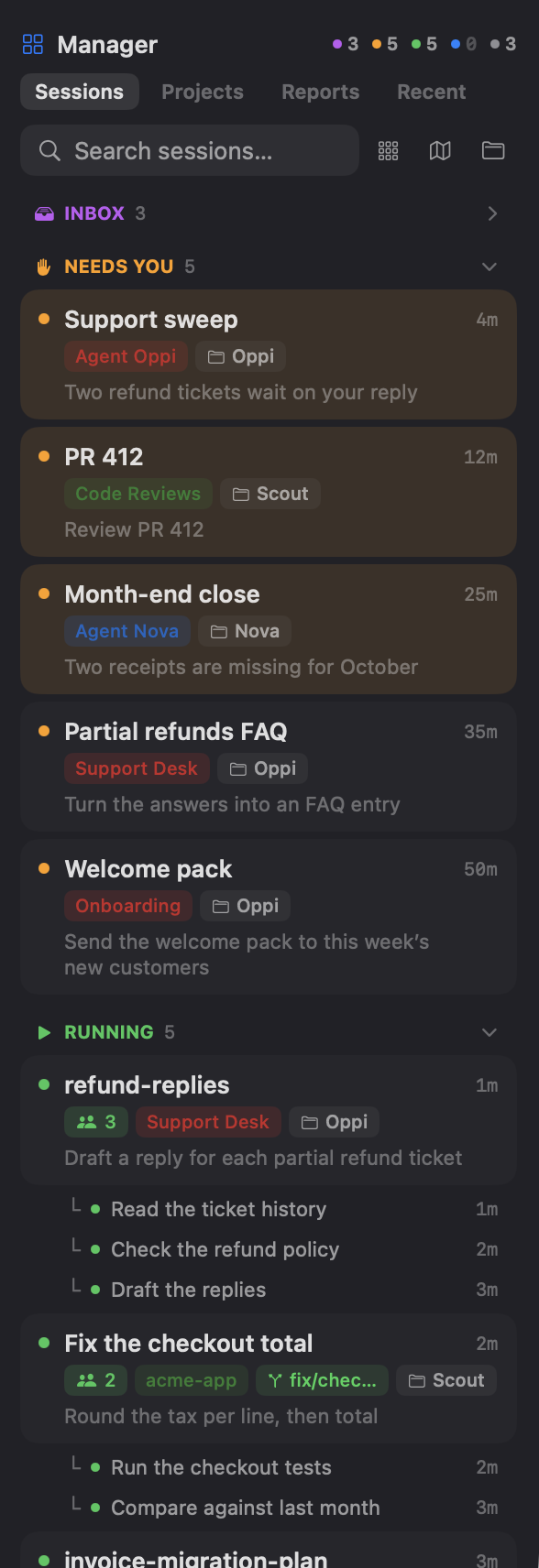
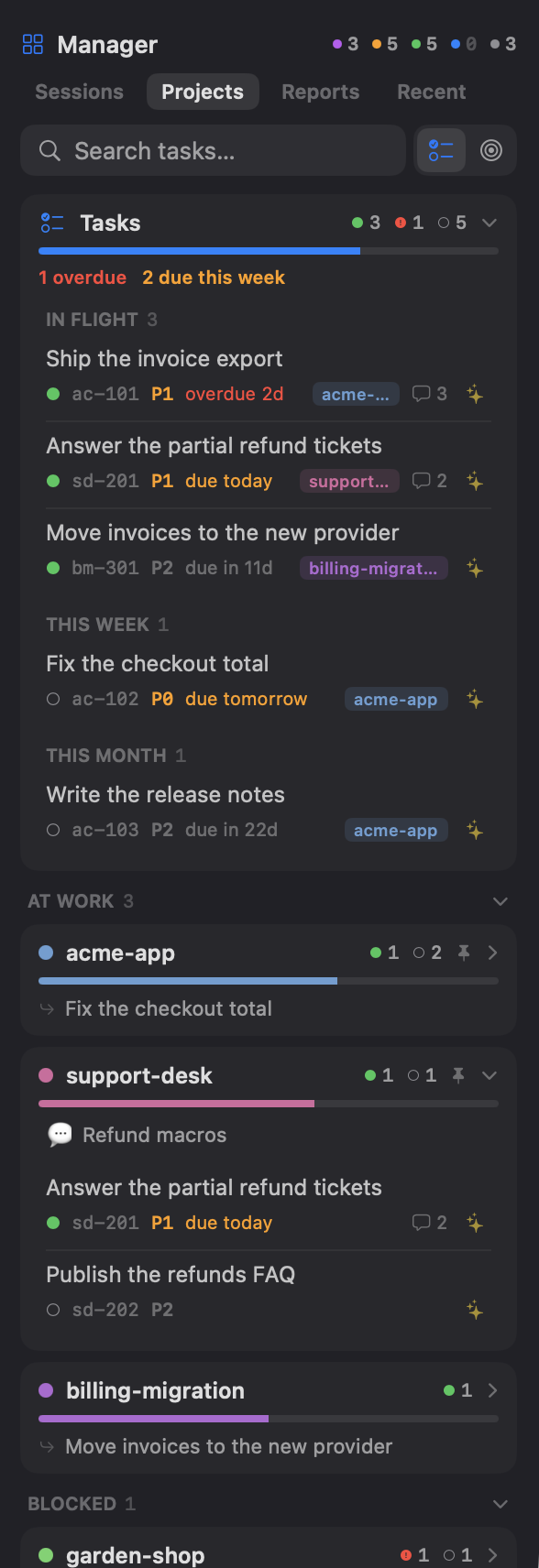
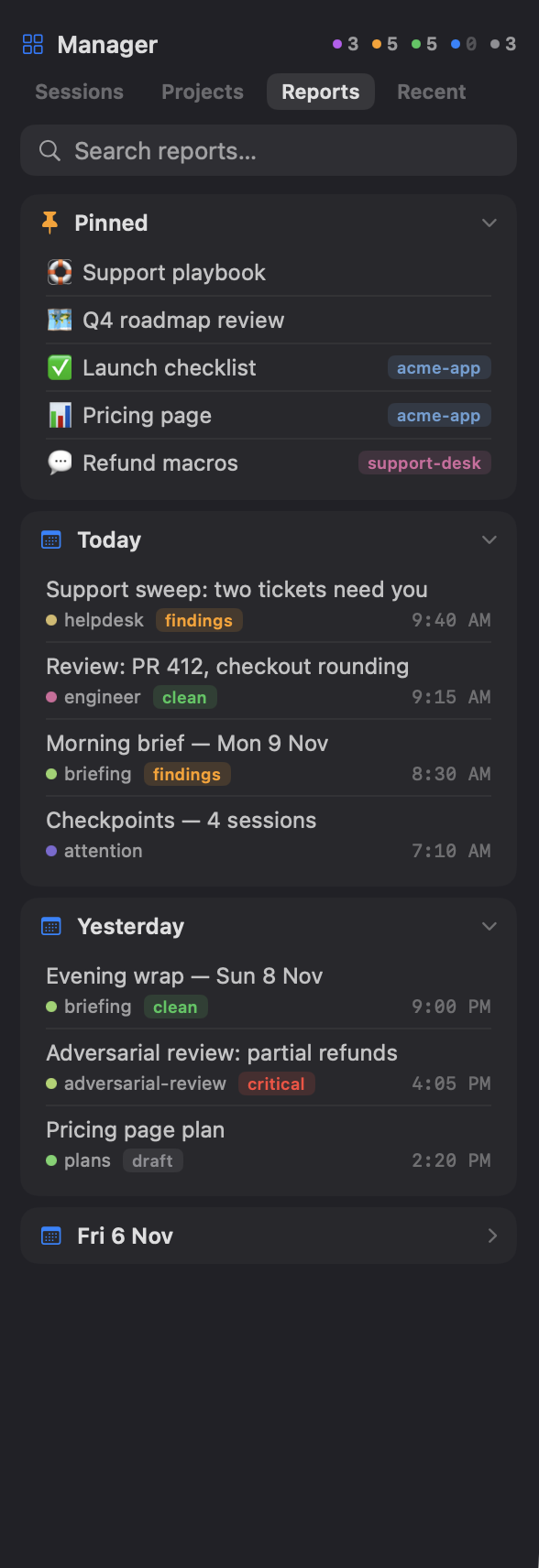

In cmux on macOS · the session manager is open source · demo agents Oppi, Nova and Scout for a fictitious company
// What it is
Three things it does.
01
It remembers.
Every conversation is saved and turned into notes it reads before the next one. Ask about a decision from March, or what you were doing last Tuesday, and it knows.
▸ “What did we decide about the pricing page?”
02
It follows your rules.
Tell it once how you like things done. It reads that every time, asks before anything it cannot undo, and keeps a record of what it did.
▸ “From now on, show me a draft before anything goes out.”
03
It does the work.
Morning briefings, task lists, plans, research, drafts, and code. Connect the tools you already use and it works in those too.
▸ “Brief me.”
// Who it’s for
Ask it the way you would ask a colleague.
You ask
- “Brief me.”
- “What slipped this week, and why?”
- “Turn the board meeting's notes into a plan.”
You get
Priorities, what moved and what went stale, every morning. Decisions you made in March are still there in June.
// Yours
On your computer. On your terms.
The folder
- SOUL.mdwho it is
- USER.mdwho you are
- knowledge/what it learned
- concepts/ideas that span projects
- memory/what is active right now
- raw/sessions, before they compile
- projects/tasks and plans
- support-desk/
- billing-migration/
- sales-pipeline/
- reports/briefs and reviews
- dashboard.htmlone file
Plain files you own.
Everything it knows is markdown in one folder on your computer. Open it in any editor, keep it in git, take it with you.
Your model.
It runs on Claude Code or Codex today, with more frontier and open-weight models coming. The memory stays the same when the model changes.
Your rules.
It reads your manual every session, asks before anything it cannot undo, and keeps a dated record of what it did.
// The brain
A brain that compiles itself.
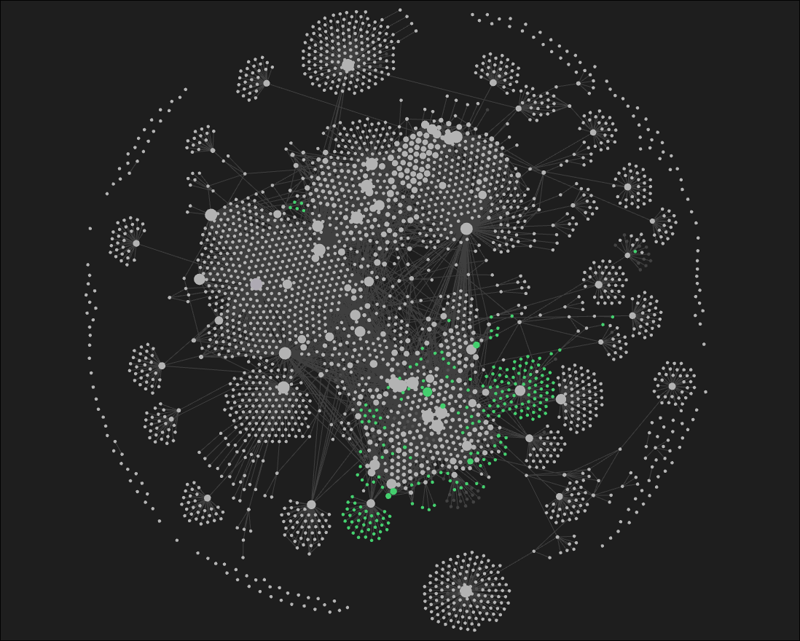
Every note links to the notes it came from and the notes it informs. Concepts sit between the projects that share them, decisions point at the sessions that made them, and a correction lands next to the rule it changed. The links are the understanding; a folder of files is just where they live.
// The dashboard
One page. Everything it knows.
When the sidebars are not enough, the dashboard shows everything the agent knows about your work on one page you can open any time: today’s priorities, your projects, who is waiting on you. It is a single file on your computer. No account, nothing to log into.
A real render · demo data · fictitious
// The pages
- Today
- your focus: today, the week, the roadmap, who is waiting on you
- Tasks
- every project on one board, by deadline, never stale
- Projects
- progress and last touch, per project, with its roadmap
- Sessions
- what the agents worked on, captured automatically
- Brain
- the compiled knowledge and what loads each session
- Reports
- briefings, audits, and reviews, dated and clickable


// Proof · Pray Watch
Context works on code too. Even ten-year-old code.
Pray Watch, our founder’s prayer-times app with over a million downloads, had all but stopped changing. We made its codebase agent-ready: a manual in the repo, the toolchain wired to the agent, architecture it can copy, and gates it must pass. Then it started shipping again.
18
lines changed in all of 2025
5 weeks
from a repo manual to a rewritten release
1 afternoon
from a new Mac target to desktop widgets and a menu bar item
// Get started
One line. A few questions. Then it knows you.
Paste the line into Terminal. It checks what you need and walks you through each step, asks what to call your agent (Oppi, unless you pick a name), and ends with the line that starts it. Then your agent asks about you and your work, and it is ready.
New to the terminal? The quickstart shows each step and what you will see. Prefer to do every step yourself? Follow the manual install.
▸ curl -fsSL https://agentlayer.one/install.sh | bashPaste into Terminal on macOS or Linux (on Windows, PowerShell takes irm https://agentlayer.one/install.ps1 | iex). It checks each step, shows you what to run, and installs nothing itself.
// For your company
Free for one. Set up for your whole team.
It starts with your engineering team. A forward-deployed engineer works inside it for six weeks, until shipping with agents is the default, and leaves behind a brain your whole company can use. Then every improvement ships to you, month to month.
30+
things you can ask it to do
80+
tools it can use on your behalf
2
apps it runs in: Claude Code and Codex
Open source
Apache-2.0: fork it, keep it, no lock-in
// Proof before promises